Articles
How to Choose for Enterprise AI Integration? On-Premise Servers vs. Cloud Services
Oct 2, 2026
Enterprise-ready solutions
When an enterprise decides to integrate AI into its workflows, the first challenge it usually faces is: should we buy an AI server to keep in-house, or rent cloud services? This choice concerns not only the budget but also the security of data assets and the stability of system operations. In the process of assisting clients with building AI systems, we have found that decision-makers are often most concerned about hidden costs and data leakage risks. Below, we will clarify the most suitable choice for you through three dimensions: security, cost, and performance.
Data Security and Control: The Core Value of On-Premise Deployment
For enterprises that value R&D patents, customer personal data, or confidential production line data, the sense of control provided by on-premise deployment is difficult for the cloud to replace. When you own your own AI server, all training data and computing processes are completed within the company's internal network without passing through public cloud transmission paths. This means the risk of data leakage is significantly reduced, and it can fully meet high-standard compliance requirements for specific industries regarding data residency and localization.
Furthermore, on-premise servers grant enterprises the highest level of customization authority. From selecting hardware specifications to configuring the operating system environment, we can perform optimized tuning for your specific model requirements without being limited by the fixed specifications provided by cloud vendors. For enterprises that need to accumulate data assets over the long term and view AI as a core competency, owning physical equipment often provides a more solid sense of security.
Initial Investment and Long-term Maintenance: The Flexibility of Cloud Services
In contrast, the greatest advantages of cloud services lie in their "low entry barrier" and "high flexibility." If you are in the development and testing phase of an AI application and are not yet certain of the final computing volume required, cloud services allow you to pay as you go, avoiding a large one-time capital expenditure on hardware. For SMEs with limited budgets that need to fail fast and iterate quickly, this is a very attractive way to start.
However, cloud services also involve "hidden costs." As computing volume increases steadily, monthly rental fees often accumulate rapidly. In the long run, the cost of using the cloud for three consecutive years may be enough to purchase several high-specification AI servers. Additionally, network bandwidth costs and data transmission fees in cloud environments often become unexpected burdens on the budget when processing large volumes of images or massive datasets. We recommend that decision-makers calculate the total cost of ownership (TCO) for the next 24 to 36 months when evaluating, rather than looking only at the first month's bill.
Performance and Latency: Computing Choices for Specific Scenarios
In practical applications, computing latency is a key factor affecting user experience. If your AI application requires real-time processing—such as real-time defect detection on a factory production line or dynamic analysis for smart surveillance—on-premise deployment can eliminate the time for data to travel to and from cloud data centers, providing millisecond response speeds. In automated production environments, this is often the deciding factor for yield rates.
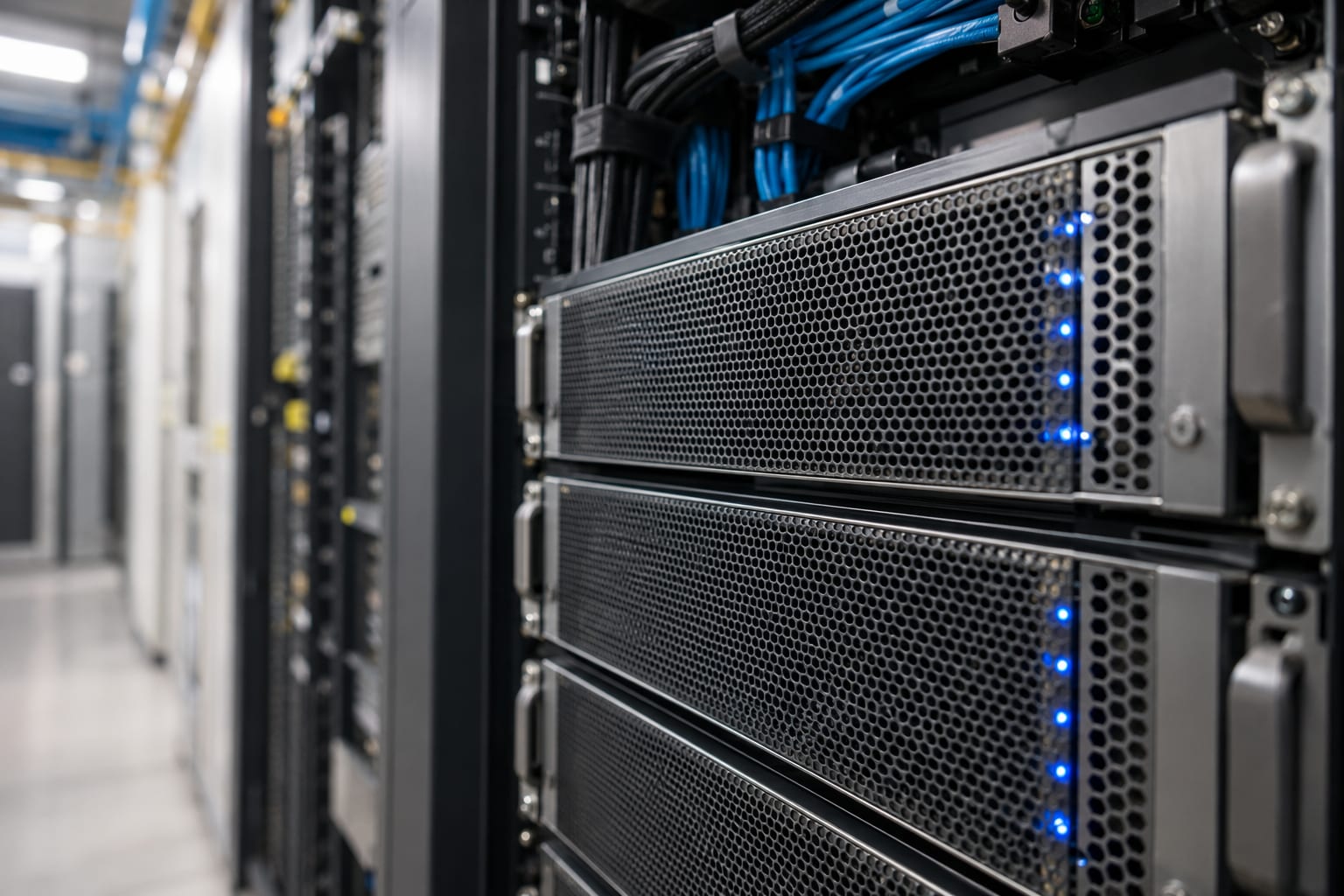
If your requirement involves mobilizing extremely large-scale computing power for model training over a short period, the cloud environment offers the advantage of instantaneous scaling. But for the daily inference applications of most SMEs, a well-configured AI server is sufficient to handle most needs. When we assist clients with planning, we prioritize reviewing where the data is generated. If the data source itself is on-premise, building the server near the data source usually results in the most stable performance and the lowest network dependency.
Hybrid Architecture: The Best Path Combining Both Advantages
Many successful transformation cases do not involve a binary choice between on-premise and cloud, but rather adopt a "hybrid cloud" model. For example: conducting energy-intensive model training and initial development in the cloud, and once the model is mature, deploying it to on-premise AI servers for daily operation and data inference. This preserves development flexibility while ensuring cost control and data security during the operational phase.
We are well aware that every enterprise's IT environment and budget considerations are different. Choosing the appropriate solution is not about the level of technology, but about whether it can be linked to your business goals. If you are at a decision crossroads, we can provide professional hardware planning assessments and subsequent technical support to ensure that every penny of your AI investment is spent where it matters most.
If you would like to further evaluate which solution best fits your enterprise's current situation, welcome to contact us.