When an enterprise plans to implement generative AI or machine learning models, the primary technical decision is not the choice of algorithm, but the configuration model of "computing assets." This decision will affect operational expenditures, data security, and technical development flexibility for the next three to five years. We have observed that many Taiwanese SMEs often fall into single-dimensional considerations during preliminary evaluations. In reality, on-premise servers and cloud services each have irreplaceable scenario advantages.
Data Privacy and Compliance: The Moat for Core Enterprise Assets
For most enterprises, data is the source of core competitiveness. During the training or inference process of AI models, if sensitive customer information, proprietary code, or undisclosed financial data are involved, the location where the data is stored becomes critical. The greatest advantage of on-premise deployment lies in "physical isolation" and "complete control." When servers are set up in the company's server room, all data flow is completed within the enterprise's internal network without passing through public cloud environments. This effectively reduces the risk of data leakage and meets the strict security compliance requirements of specific industries.

In contrast, while cloud services provide comprehensive security mechanisms, data must still be uploaded to third-party platforms. For R&D units or financial services handling highly confidential data, the psychological security and substantive control provided by on-premise servers are difficult for cloud environments to fully replace. We suggest that if your AI application scenarios involve large amounts of private data, prioritizing on-premise deployment can save complex subsequent compliance audit costs.
Financial Perspective: Balancing Capital Expenditure and Operating Expenses
From a financial cost perspective, on-premise and cloud represent two completely different logic systems for capital utilization. On-premise servers fall under "Capital Expenditure" (CAPEX), where enterprises need a high one-time investment to purchase server hardware equipped with high-performance GPUs. Although the initial threshold is higher, the average cost per unit of computing power continues to decrease over time. For enterprises with stable AI computing needs and long-term operational plans, the Total Cost of Ownership (TCO) of self-built on-premise facilities after three years is typically lower than long-term cloud rental fees.
Cloud services fall under "Operating Expenses" (OPEX), using a pay-as-you-go or subscription model. This is very friendly to enterprises with limited budgets or those still in the experimental stage. You don't need to invest millions of TWD in hardware at the start; instead, you can adjust the amount of rented resources at any time according to project progress. However, the unit price of cloud computing usually includes a service premium. If an enterprise's AI application has entered a mature stage of 24/7 continuous operation, high monthly bills can become a financial burden. We assist clients in breaking down computing budgets to determine the best timing for migrating from the cloud back to on-premise.
Performance and Latency: Practical Demands of Edge Computing
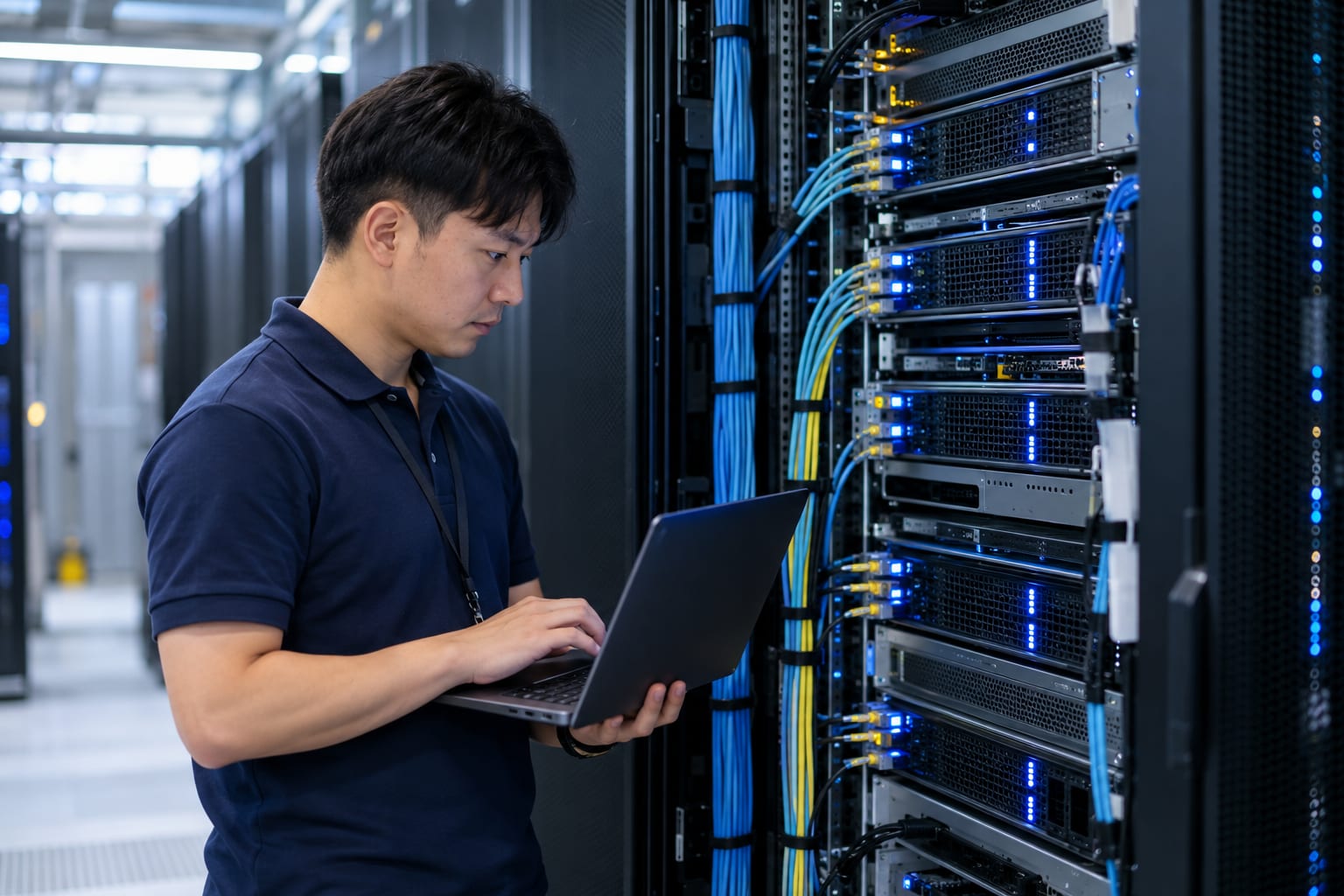
The response speed of AI applications often determines the user experience. In scenarios such as factory automation inspection, real-time medical image interpretation, or smart surveillance, data transmission "latency" is the key to success. On-premise servers can perform computations directly at the site where data is generated, without the round-trip through the internet, ensuring millisecond-level response speeds. Furthermore, when processing large 3D models or ultra-high-definition video, the bandwidth advantage of internal networks far exceeds cloud transmission.
However, cloud services have an overwhelming advantage in "scalability." When your project suddenly requires massive parallel computing or needs to test different GPU models (such as H100, L40S, etc.), cloud platforms can provide immediate resource scheduling without waiting for hardware procurement and installation time. For applications in a rapid expansion phase with highly fluctuating computational loads, elastic cloud deployment is a good choice to diversify technical risks.
Operations and Maintenance: Technical Capability Thresholds for IT Teams
Finally, software and hardware maintenance capabilities must be considered. Building on-premise AI servers means the enterprise must bear the responsibility for server room environmental control, hardware troubleshooting, and the deployment and maintenance of software environments (such as CUDA drivers and containerization platforms). For small enterprises lacking professional IT operations personnel, this is an invisible burden. When we provide AI server construction services, we simultaneously plan comprehensive technical support and warranties to ensure customers enjoy on-premise advantages without being locked down by hardware management.
Cloud services significantly simplify operation and maintenance difficulties. Service providers are responsible for hardware-level stability, and developers only need to focus on model development. This "maintenance-free" characteristic is suitable for technical teams whose resources are concentrated on application development rather than infrastructure management. When making decisions, enterprises should simultaneously evaluate internal IT manpower allocation or seek professional external partners for managed services to achieve the maximum synergy of AI investment.
Choosing AI infrastructure is not a rigid binary choice; more enterprises are beginning to adopt a "hybrid cloud" strategy, keeping data development on-premise for privacy while placing elastic, scalable services in the cloud. To evaluate the right solution for your business characteristics, welcome to Contact Us.